Showing posts with label comics. Show all posts

Thursday, March 22, 2012

I’m Back. Maybe. Sorta. We’ll See.

Yikes. It’s sure been a while since I last posted anything here. Plenty has happened, no time to write it down. Or something like that. Anyway, one interesting thing – in the context of this here blog, at least – is that I now read comic books on a regular monthly basis again. It started slowly. Check out a series here, pick up a series there. Oh, hey, that graphic novel looks good. Let’s give it a shot. Then it became a small, but steady stream of monthlies. I also discovered digital comics and that allowed me to check out some writers and artists that I was unfamiliar with since my last serious regular buying, which was probably sometime in 1993.

So, it was slow and steady and very fun to begin weekly treks to the local comic shop (LCS). During this time I wasn’t buying many superhero comics as I avoided most monthlies from DC and Marvel as everything seemed to be tied to some big “event” with universe-defining crossovers. I tired of “events” back in 1992; I wasn’t going to use my newly found comic reading time on such nonsense again. So I avoided the Big 2 and stuck to the little guys and comic genres like horror, crime, and monsters. Good stuff really. But I missed the capes and tights.

Then, in September 2011, DC Comics re-launched their entire line of superhero comics, starting each at number 1. Sure, this was just another gimmicky event in many ways, but it also provided me an opportunity to jump right into the action.

Now, 7 months after DC’s “New 52” re-launch, I am completely ensconced in around 40 (!) monthly titles from a half dozen publishers. My plan is to use this blog now as a comic book review/thoughts/essays forum. I’ll, at least, update it weekly with a list of the week’s haul and try to provide timely reviews and thoughts as well. We’ll see how it goes.

Last week's recommendations:
Exile on the Planet of the Apes #1 (Boom)
Fantastic Four #604 (Marvel)
Frankenstein: Agent of SHADE #7 (DC)
Saga #1 (Image) *Pick of the week*

This week’s haul:
Eerie Presents: Hunter HC (Dark Horse)
Justice League #7 (DC)
Planet of the Apes #12 (Boom)
Ragemoor #1 (Dark Horse)
Rocketeer Adventures 2 #1 (IDW)
Wonder Woman #7 (DC)

Sunday, January 14, 2007

COMIC BOOK REVIEW: Shock SuspenStories


EC Comics collects the first 6 issues of Shock SuspenStories, originally published in 1952, as part of its EC Archives editions. Included with the stories are the editor’s columns and letters page as well as the ads that ran in the original editions. The influence of these stories can be seen in so many comics, movies, books and TV over the last 50 years.

Shock SuspenStories served as EC’s “sampler” comic. It contained horror, crime, science fiction, and war stories. In addition, they also included another category: the “shock” story. These tackled social issues from racial injustice in the southern United States to the Red Scare. I’m no comic historian, but these, to me, are eons ahead of their time than other 1950’s comics in the message of tolerance. Of course, to live up to the billing of being a “shock” story, many aspects are bluntly and crudely portrayed, but with only 7 or 8 pages to work with, I’m sure the reading audience didn’t mind the intrusion of a political viewpoint in their horror stories.

Even at it’s silliest – and there are some silly stories in here – there’s always at least one panel of artwork in each story that is just amazingly presented. The larger size of this hardback with glossy paper in full color really brings the artwork home. There’s even a short essay about the innovative lettering style some of the EC artists employed.

Many of the stories rely on the twist or surprise ending, many of which are telegraphed way ahead of time, mostly because in the last 50 years, this method has been copied many times over. Regardless, it’s always fun to get there. This collection is essential reading for any comic book fan.

Saturday, December 23, 2006

COMIC BOOK REVIEW: Superman: Red Son (DC Comics)


DC Comics’ Elseworlds line is described as thus: “In Elseworlds, heroes are taken from their usual settings and put into strange times and places – some that have existed and others that can’t, couldn’t, or shouldn’t exist. The result is stories that make characters who are as familiar as yesterday seem as fresh as tomorrow.” Just as in Marvel Comics’ What If…? series, this premise allows writers to weave stories that may not fit the hero as we know them and not to worry about the regular continuity of the respective comics universes. This premise can provide hits or misses. Superman: Red Son is most definitely a hit.

Originally published as a three issue mini-series in 2003, and now available as a trade paperback, writer Mark Millar, pencillers Dave Johnson and Killian Plunkett, and inkers Andrew Robinson and Walden Wong do a more than admirable job of re-imagining the Superman myth. Superman, that iconic symbol of truth, justice, and the American way is now a Communist. In the mid-twentieth century, a rocket ship from an alien planet crashes onto a collective farm in the Ukraine rather than the Kent’s farm in Kansas. Interestingly enough, the values he learned on that collective farm do not seem that far removed from the values he learned from Ma and Pa Kent.

The story begins with Superman making his presence known in Moscow as an adult. Stalin sends a communiqué to the rest of the world: “Let Our Enemies Beware: There Is Only One Superpower Now.” As true as this appears readers familiar with the Superman saga know that Lex Luthor is still an American. Nonetheless, President Eisenhower still laments about how if that rocket only crashed into Earth twelve hours earlier Superman might be an American.

Along with Lex Luthor the rest of Superman’s friends, enemies, and fellow heroes make appearances. There’s Lois Lane, Lana Lang, Jimmy Olsen, and Perry White. Superman’s rogues’ gallery is still Lex, Braniac and Bizarro. Working from the concept that Superman was the lynchpin for all other DC Superheroes, the story introduces us to other well-known faces in unexpected ways. Batman is around, in a post-Dark Knight Returns incarnation, that plays foil to Superman’s new socialist values, and we learn what kind of heroes Wonder Woman, Green Arrow, The Flash, and Green Lantern have become now that Superman is a Soviet hero.

An insider’s knowledge of the DC Universe can add to the overall cleverness of this set-up but even knowing the Superman myth in only broad strokes will not endanger enjoyment of the story. From the hammer and sickle replacing the S on Superman’s chest to President Kennedy, now married to Norma Jean, and dealing with civil strife and a triumphant USSR, to a play on Superman’s disguise of wearing glasses, there is much to be found different yet familiar. There’s even a reference concerning exactly these types of re-imagined stories. The greatest strengths of Superman: Red Son is that it changes the Superman myth without changing Superman himself and it has an ending that sheds new light on that myth.

Tuesday, August 15, 2006

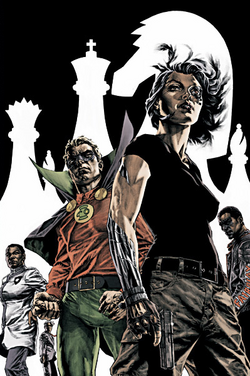
COMIC BOOK REVIEW: Checkmate #4 (DC Comics)


In my review of Checkmate #1-3, I covered my initial and, somewhat underwhelmed, impression with the caveat that I should wait until the story arc was completed before making a summary judgment on the merits of the series. After reading Checkmate #4, I was correct to include that out for myself and wrong to be so cynical of the first three parts.

Checkmate #4 is fast and furious fun. It balances the geo-political reality that Checkmate navigates and pure superhero fun quite masterfully. Checkmate’s excursion into China and the match-up with the Chinese meta-humans works so well if only because of the forceful personalities of these newly introduced super-powered bunch. Greg Rucka handles the interaction between Checkmate’s expressed (and covert) duties and the Chinese’s responsibilities to country with superb fluency. This could have quickly played like a hackneyed cold-war era confrontation. Instead, with a few detours, we see shared respect and mutual admiration between the factions. The Chinese heroes also have fun names like Physician, a stately and sage looking man, and The August General in Iron, an imposing, hulking figure donned in an iron shell. The artwork of Jesus Saiz creates a beautiful tableau for all these characters to act on. And the devil is in the details: the Physician’s hands nobly behind his back during his confrontation with the dubious Count Vertigo; a glean in the eye of Black Queen Sasha Bordeaux during her conversation with the Celestial Archer. We see and hear the fullness of these persons through the words and art.

Perhaps, the only slight level of disappointment that remains is Green Lantern’s naivety. Is he this noble? And if he is, why can’t he work some political finesse into it? He overplayed his hand it seemed when he didn’t need to. Couldn’t he bring about the same resolution to the problem without letting White Queens Amanda Waller in on what he wished to achieve? But one bright spot is the newfound comradely respect between Alan and Sasha. That’s an important collusion for the health of Checkmate.

Monday, July 10, 2006

COMIC BOOK REVIEW: Checkmate #1-3 (DC Comics)


The bulk of my comic reading was done between, say, 1985 and 1995: ten strong years of Marvel, DC, and plenty of crappy Independents (this was, remember, during the B&W explosion). I tailed off since that time, buying the odd Vertigo title, and, perhaps, a trade paper back collection of Miller or Moore or Gaiman’s latest. Rare is the new monthly series that compels me to purchase.

I remember the original Checkmate vaguely. I remember enjoying it. It had an alluring mix of international spy story and superhero goofiness. In other words, I had hoped it would use superheroes in espionage stories and not vice versa. Mostly, though, it was vice versa: the broad strokes of the waning years of cold war reality laid the groundwork for broad international intrigue with entertaining results. I should invade my parent’s basement and dust off those old issues and see if they hold up to the above description as I’m hard pressed to recall even one plot point of the series. In the meantime, there’s a new Checkmate series written by Greg Rucka and drawn by Jesus Saiz. I’ve read a few of Rucka’s Queen and Country TPBs and enjoyed them immensely (I’ve not yet waded into his novels). Based on my memories of the old Checkmate and my admiration for Q&C, I looked forward to Rucka’s Checkmate. So far, after three issues, the result has been middling.

Let me begin by saying that the “From the Pages of Infinite Crisis” blurb on the cover of #1 made me nervous. I know nothing of the current DC universe. I don’t read any current comics. In fact, it was the absurd and poorly conceived crossover “events” every year that led to the curbing of my comic reading in the mid-90s. Fortunately, no storylines elsewhere in the DC Universe interfered with the first three installments of the premiere Checkmate story arc, “The Game of Kings.”

In a nutshell, Checkmate is an arm of the United Nations. Their UN charter renewal is blocked by China. Checkmate now has a week before it closes up shop. So, they need to 1) find out why China opposes their existence and 2) convince/blackmail China to allow another vote on the charter resolution so that Checkmate is not disbanded. There’s also a group of bad guys called Kobra that may or may not have some influence on China’s decision. A higher-up of Checkmate is also Chinese and his patriotism may outweigh his allegiance to Checkmate. And the Chinese may or may not be wary of the American influence in the top echelon of Checkmate – a worry that seems not without merit to others inside of Checkmate.

An interesting aspect of Checkmate’s charter is that for every super-powered member of Checkmate there must a non-powered member. There’s also clever use of chess jargon (keep in mind I know little of chess. What’s clever for a chess novice – and here I’m being charitable with myself - may be viewed as pedestrian by a seasoned player). We have White King, White Queen, White King’s Bishop, White Queen’s Bishop and so on. The corresponding Black counterparts exist as well. The White squad deals with the politics. The Black squad deals with the tactical operations and field maneuvers. There’s some nice play between the White King, Alan Scott (Green Lantern) and the Black Queen, Sasha Bordeaux. Scott doesn’t like Bordeaux’s body count on missions. Apparently, he’s laboring under the misapprehension that everyone is in possession of a green ring that can foil people without killing them. (In issue 3, Kobra also sends an assassin after Scott wielding nothing more than a stake dipped in poison. Kobra doesn’t have better ways to deal with a Green Lantern? And yet they’re the main organized threat to Checkmate?)

Perhaps, it’s unfair to call the story average in the middle of its first story arc, but for all that is described above, there’s no real gripping storyline yet: Checkmate v. Kobra: not really fleshed out yet; Checkmate v. UN: so far, it’s convoluted and boring; Checkmate inter-squabbling: predictable. Hopefully, once the story progresses the twists and turns will prove to not be convoluted or predictable. I’ll stick with it until the conclusion of this first arc and decide whether this series is a keeper or not.