Monday, July 14, 2008

ETHIOPIA: Hail Mercato


I visited the Mercato, which is considered by some to be the largest open-air market in all of Africa. Other than reading about how you can buy anything from “camels to Kalashnikovs” and making a mental note to visit while staying in Addis I really didn’t give it much thought. It seemed whenever you mentioned Mercato to anyone, especially tourists of a pale complexion, the response always was “Don’t bring your valuables.” I just figured precautions are necessary as with any large gathering of people. So off the Mercato I went. I jumped on a mini-bus, which I am utilizing to various degrees of success, and 45 minutes later I was there. I think, in some corner in the recess of my mind, the recess influenced by romantic notions of other cultures, fueled by comic books and movies, I was hoping for a bazaar like the one Indiana Jones visits in Raiders of the Lost Ark, only on a grander scale. I was hoping to see exotic people selling exotic wares. I was hoping to return with an armload of exotic items deemed necessary to have by the sheer existence of the market itself. Boy, was I sorely disappointed. It’s just a big, dirty, impossibly crowded flea market. Blocks and blocks of stalls and shops selling the same knock-off junk you can find in any shop anywhere in Addis. Rain prevented me from exploring all of the Mercato, so I am giving it a short shrift here but I never did see any camels or guns for sale. (I am told that there are things in the Mercato you can’t get anywhere else you just have to know where to look.)

I was supposed to meet my friend Christian, who I mentioned as being scammed upon his arrival in Addis. We decided to meet at the bus station as it was thought to be a central location and we are taking a trip this week that includes bus travel so it would also act as a recon mission. While walking through the Mercato towards the bus station it began to rain. It was then I found out that there are two bus stations, one for long-distance service and one for short distance. I reached one of them (I could never get a straight answer as to the one I was at), as the rain became a downpour. After a quick walkabout to determine that Christian was not there I took shelter in the bus station for about a half-hour. A bus station in Addis attracts the same sort of people any bus station anywhere attracts. Just think Port Authority in a developing country. The downpour was so great that it was difficult to get away from the spreading puddles. My shoes and the cuffs of my pants became soaked. The rain started to dissipate and I set out anew to locate Christian and explore.

Walking through the Mercato, I encountered a new refrain targeted at farangi, “YOU! YOU! YOU! YOU!” with a miffed “HEY!” thrown in when ignored. This is every bit as annoying and obnoxious as the caps indicate. Blocking the never ending YOU’s from my mind I stopped in a pastry shop for some tea and cake (mmmmm, cake), then used a phone at a neighboring shop and called Christian on his mobile. He was at a different pastry shop, which he said was by the bus station. I ventured back to the bus station not realizing, until informed later on, that he was at a different bus station, popping my head into every pastry shop as I passed. A downpour began again. I decided to cut my losses and catch up with Christian later. I was overconfident from the little time I spent in the Mercato and my two trips to the bus station. I thought I could take a short cut back to the minibus stop. The cobblestone path I was following curved to the left and opened to a terribly muddy road. The rain caused filthy water to stream down this road. My already wet shoes and pants became ever more wet and disgusting. I mean really disgusting. I followed this muddy, filthy road and then realized that there were no more shops. I ended up in an alley in the back of the shops. There was a lot of activity: hammering, welding, chat chewing in the doorways, normal Ethiopian loitering, all done in the rain in the muddy road. I really didn’t belong here. The looks I got while walking through weren’t the normal farangi looks. These were bewildered looks. “What in the world are you doing here?” the looks asked. I could only provide them with a look back indicating that I was as surprised to be there as they were to find me. (I was thinking of the Dave Chapelle joke where he ran into another black person at a hotel in Aspen, CO while this was going on.)

Eventually, I saw some hustle and bustle in front of me and was unloaded from the mud to the Mercato. This wasn’t much of an improvement. While some of the roads through the Mercato are asphalt this just causes fast flowing rivulets of dirty water to race down them. Other than my upper body, shielded from the elements by my trusty rain jacket, I was soaked. Swamp foot was beginning to settle in as my Montrails are not waterproof. Great shoes just not in the rainy season. (My shoes are still filthy. I need to let them soak in a bucket of Purell to clean and sanitize them.)

I left the Mercato on the first minibus I was sure was going in my direction. It wasn’t the route closest to Mr. Martin’s but it was close enough. The downpour picked up on the drive back. Bole Road was like a river. Traffic was snarled as vehicles were stalled in the middle of the road due to the high water. Minibuses just plowed through angrily honking at the unfortunate victims of nature’s wrath. I looked through the fogged up windows and noticed white stuff on the ground. I wiped the glass clean to gain a better perspective. It was now hailing out. The hail was piled high. (12 centimeters high as it was reported on the news. An Ethiopian friend, who was out of town, asked me to confirm the 12 cm measurement. I just said, “Yes” without getting into the fact that off the top of my head I don’t know how high 12cm actually is. He knows I don’t do metric) I get to my stop but I am on the wrong side of the street. It is still pouring out and there is no way I can cross without wading through up to my calves. I stopped in a restaurant and got some lunch. By the time I was done eating, the rivers stopped flowing down the road and the sun was out. I walked back to the Cozy Place and showered the filth of the Mercato off of me.

Photo from minibus. Notice the hail in foreground:


Hail:


The road directly after it stopped raining:

ETHIOPIA: In the meantime...


I just returned from a long weekend in Bahir Dar. It rained quite a bit but that did not dampen any enjoyment. It is colder in Addis than i left and I might have caught a cold. Damn. It took a 16 hour bus ride to get to Bahir Dar but was worth every second. I had a fantastic time. I'll have to get some posts together to describe everything starting with the bus ride, which was quite the experience. It was great to see the countryside and some villages and get out of Addis. As the bus left Addis, the air cleared, and I saw the expanse of mountains around me I felt like Morgan Freeman's character Red in The Shawshank Redemption as he broke parole and crossed state lines in a bus. My head was sticking out the bus window (although it could easily have been) but my journey provided me with the same feeling of elation.

Until I get my thoughts together about this past busy weekend I'll post some filler musings of mine that have been sitting in the docket. To start with here is my trip two weekends ago to an outdoor market place in Addis, which I did not get a chance to post last week.

Wednesday, July 09, 2008

ETHIOPIA: Out of Addis


Leaving for a 12-hour bus ride to Bahir Dar early tomorrow morning.* First time I will be leaving Addis Ababa since my arrival. I am looking forward to it (not the 12-hour bus ride but getting out of Addis.) I will spend the weekend visiting the monasteries on Lake Tana and the Blue Nile Falls. The Blue Nile Falls is one of the cited sources of the Nile. It seems that every African country in this region claims to have the source of the Nile. Since I am in Ethiopia I am going with its claim. I will see the source of the Nile. Since it is the Nile I was hoping to glimpse some crocodiles but that appears doubtful.

Be back blogging next week.

*I think we are leaving then. I went to buy a bus ticket this morning and was told that the bus is full. The agent sold us tickets, gave us his cell phone, ordered us not to show anyone the ticket because he is telling everyone else that the bus is full, and to call him tomorrow morning when we arrive at the bus station so he can get us passage on a full bus. It seems very fishy but locals say that is the way the bus station works. I expect to get on a bus tomorrow but also expect I may be surprised where I end up after 12-hours.

Monday, July 07, 2008

ETHIOPIA: Independence Day


On July the fourth I was out with some other Americans. The subject of American indepedence came up and someone commented how the United States is doing pretty good with 232 years under its belt. This statement made us reflect upon Ethiopia and how they celebrate no independence day because they are the only African country to not be colonized. This is a fact that many Ethiopians mention frequently and of which they are very proud. Since Ethiopian history goes waaaay back they have been a country for much more than 232 years.

For several years during WWII Ethiopia was occupied by Italy. Resistant fighters prevented the Italians from taking over the entire country and self-rule was returned in the aftermath of the war. (Well, self-rule in the form of an emperor and the royal family.) Other than Ethiopia being an independent country in between Somalia and Eritrea, two Italian colonies, there was no strategic reason for Italy to invade Ethiopia in 1935. Many Ethiopians call the invasion and occupation "Mussolini's Revenge" as it is widely believed that the main reason to invade was to put the Ethiopians in their place for thier stinging defeat of the Italians at the Battle of Adwa.

The Battle of Adwa occurred in 1896 and is widely considered one of the greatest triumph's of Africa against colonial Europe. The Batte of Adwa is celebrated nationally with days off just like the Fourth of July in the U.S. During the battle Ethiopian forces routed an invading Italian army preventing any further encroachment of the Italians into Ethiopia from Eritrea.

A couple of Ethiopians have told me that the Battle of Adwa still resonates today as some of the reason for bad blood between Ethipia and Eritrea. After acheiving victory at Adwa, the Ethiopians allowed the Italians to retreat back to Eritrea. They seemed happy enough to win the battle and not give chase. Then later on Emperor Haile Selassie declared Eritrea part of Ethiopia resulting in a "Where were you in 1896?" response and Eritrea's determination to remain independent.

One reason Ethiopia may want Eritrea to be part of them is contained in another oft mentioned fact you hear from Ethiopians: how they are a landlocked country. Having Eritrea within Ethiopia would solve that problem. But due to the obstinance and intransigence of both countries the borders between them are closed (and under dispute) and Ethiopia is still landlocked and with no access to Eritrea's port.

Friday, July 04, 2008

ETHIOPIA: Rudy


Rudy is a monkey kept at Mr. Martin’s Cozy Place. It can be looked at as the Cozy Place mascot, Mr. Martin’s pet, or if you are so inclined, a monkey companion. A couple years ago, Dawit, the manager, who was recently married, found Rudy on the street a couple blocks away from Mr. Martin’s. He noticed a commotion with some kids and upon investigation saw them teasing a two-month year old monkey. Dawit rescued Rudy from these young tormenters and brought him back to Mr. Martin’s. They built him his small compound on the Cozy Place premises and he has been there ever since. Dawit doesn't like keeping him in a cage but feels it is better than living on the mean streets. He’s a rambunctious little guy and I don’t think he likes me much based upon his clawing at me during petting attempts.

Rudy sleeping:

Thursday, July 03, 2008

ETHIOPIA: Eureka!


After a month of poring through boatloads of data, learning how to use two databases (kinda how to use), and conducting research on previous literature that used similar variables, I have finally, finally, narrowed my focus and know what I will be working on for the remaining two months.

I will be analyzing malaria data collected through a 10-year retrospective study of 20 kebeles (villages) looking at the impact of indoor residual spraying (IRS) and climatic factors on malaria transmission. Specifically, to see how effective IRS has been over that time period and determine the best time of year to apply IRS in regards preventiveness of malaria. Along with the timing of IRS is the impact of climatic factors (rainfall and temperature) on overall transmission rates. I also want to look at climatic factors for its effect on transmission coupled with IRS and as independent variables. For example low nighttime temperature has been shown to decrease transmission due to nighttime biting behavior of the mosquito vector species, Anopheles arabiensis.

There are still some confounding factors that need to be controlled. But within the data I believe it can be controlled. And I am hoping to be able to include a kebele-kebele comparison as well as a 6-month/6-month single kebele comparison as the IRS protectiveness lasts up to half a year.

I found a good model to follow from a study a conducted in Eritrea that did show a decrease in transmission following an effective vector control program. The difficulty lies in keeping the focus of the analysis manageable and narrow. There is so much data that there is an urge to add in more variables in an attempt to conduct a “complete” study. (I have that urge, anyway.) This only makes the study unwieldy. Already, I am unsure if I will complete the analysis I want to in the next two months. But it is certainly exciting to try.

Wednesday, July 02, 2008

DVD REVIEW: The Orphanage


The set-up of The Orphanage, a gothic horror chiller from Spain, follows many standard gothic tropes of character, place and atmosphere: a woman returning to her childhood home unearthing lost secrets from the past; a defunct lighthouse sitting atop a dark cave on a beach; doors windows and playground rides shutting and moving on their own volition; a young boy with imaginary (or ghostly) friends; and a menacing child hidden under a burlap sack (OK, that may not be a classic Gothic trope, but it should be). The bumps in the night and the jarring misdirection scares are aptly played here and the execution is familiar but refreshingly unpredictable (refreshing in that it doesn’t rely on gimmicky twists).

In fact, The Orphanage is matter-of-factly straightforward: Laura, an adopted orphan returns to her orphanage as an adult with her husband, Carlos, and son, Simón, to re-open it as a home assisting children. Her son quickly makes friends with children not seen by anyone. Then, during an event on the grounds of the orphanage, Simón disappears. Laura spends the rest of the film investigating what happened to Simón and the spooky circumstances behind it. The power exists in how many scenes from the first half are mirrored in the second: a flashback to a childhood game at the orphanage morphs into an act of desperation; Laura’s motherly interactions with her son become vital memories as she closes in on the mystery.

What truly drives this movie is the focus on Laura. Many scary movies get lost in the plot of supernatural malfeasance and how characters are affected. The Orphanage, however, focuses on how Laura deals with these possible otherworldly circumstances. A new level of psychological allegory is revealed that sends a shudder down the spine better than any shutting door or creaking seesaw. Highly Recommended.

ETHIOPIA: Hiding in Plain Sight


A friend recently made the comment that while Addis seems to have a bustling ex-pat community you rarely see them out and about. This proved true after visiting some farangi bars over the weekend and a recent visit to a relatively upscale restaurant. While wandering the city you can feel as if you are the only white person in Addis. The locals also act that way. After a while the cacophony of “Mister! Mister!”, “Hello! Hello!”, “Clean shoes?”, “Taxi ride?”, and “Money! Money!” blends into the rest of the din of Addis. It becomes not unlike the horn honking, the hawking vendors, the animal noises: it’s just something heard but not listened to.

Then you step into a certain restaurant and you realize that there are more white people in this single room than you have seen in all your wanderings. You wonder where they are all day. Do they ever leave the familiarity of western establishments; do they ever leave the security of their housing compounds? Then again, they are probably wondering the same thing about me.

Monday, June 30, 2008

ETHIOPIA: Scamithopia


I have been attempting to get cultured in Ethiopia. During my first weekend, while wandering around trying to orient myself, I ended up at St. George’s Cathedral and Museum and a couple weekends ago I went to the National Museum.

Going to St. George was not so much my destination as it was trying to avoid some guy who sidled up to me and walked alongside for way too long. I was headed to the National Museum that day when this guy sidetracked me, chattering in broken English about such inanities like Hollywood stars and gossip. At first I politely responded to his queries: “I really don’t know anything about what Paris Hilton is up to.” Then I realized that eventually he was going to ask me for money. I just stopped responding to him and even walked ahead of him and crossed a street or two without him knowing. But he always ended up next to me spouting some idiocy about America he gleaned from some bad show on satellite TV. He was like a bad rash I couldn’t get rid of. Finally I told him “I am walking the city alone because I want to be alone.” That didn’t deter him. I saw St. George’s across the street and crossed over to it. He followed. I reached the entrance and he realized that I wasn’t about to pay his fee into the grounds. He went on a spiel about how he lives with his grandmother and how he showed me so much while walking that I should give him some Birr. I just left him behind. He was a real birr under my saddle.

This is one of the real nuisances about Addis Ababa. If it’s not shoeshine boys or taxi drivers compelling you to take their service there is always someone who just walk next to you talking, hassling you, trying to entice you to part with your money. This isn’t event he beggars. Three times it happened during my last constitutional through the city. This time I was returning from the National Museum and enjoying a long walk on a sunny afternoon. Because the roads are all over the place and the street signs suspect I often reference the map in the guidebook. Taking the guidebook out of my bag is like chumming the waters. Out of the woodwork people come up to me wondering what I need, how they can be of assistance, what can they show me for some Birr. And once they get next to you it’s impossible to get rid of them. Their leech-like abilities are remarkable, which is why I am now remarking upon them. So since my first run-in with the guy at St. George’s and a story told to me by a German named Christian, staying at Mr. Martin’s I am not very polite or talkative to these hangers-on. Incidentally, on this same day, I noticed the first guy from St. George’s, his mouth endlessly yapping, walking with another white guy.

So Christian’s story. On Christian’s first night he went out to walk around or get a bite to eat. A man approached and said he was from the tourism board and that he noticed Christian just arrived. He welcomed Christian and asked if he would like to see some “cultural show” with “traditional dancing.” (These words are in quotes, not because of my love of quotation marks but because this is classic Ethiopian scam talk.) Christian agrees that this may be a fun opportunity and follows the man. As they are walking more men join the group. Soon they are in a shantytown. They ask Christian if he can purchase soft drinks. Christian agrees. Next thing they are in a shanty and liquor and soft drinks are being served and dancing, not very traditional as it is described to me, occurs. The dancing and music stop and Christian is presented with a bill for Birr 1000. He ineffectively argues about the bill and ends up paying Birr 800.

Now, as Christian was explaining this to me, I interrupted at the point they were entering the shantytown. “This sounds like…”
“Yes, just like it is in the Lonely Planet guidebook.”
“But…”
“I read it too but realized too late. I was in a shantytown. What was I supposed to do?”

I should have just copied and pasted the Lonely Planet description of this scam, which they call the Siren Scam. It happened to Christian exactly as described in the Lonely Planet book down to the mentions of “cultural show”, “traditional dance,” and a Birr 1000 bill. I have some sympathy for Christian, as I am not sure what I would have done if I ended up in a shantytown hovel being asked for exorbitant amounts of Birr. I don’t even carry that much Birr on me so I probably would have just shrugged my shoulders. “I have Birr 10. Does that cover soft drinks?”

Two of the hucksters who approached me recently brought up “traditional dance” and “cultural show.” The first guy was smooth talking and nicely dressed (a key player in the scam as mentioned in Lonely Planet) and after he described the dancing and culture I could see how someone could be enticed. If I wasn’t forewarned I might have gone with him. But don’t they realize that with the limited amount of white people in Addis we might talk to one another about scams like this. I think it is a decent scam, though. Partly due to wanting to trust strangers in a foreign land as well as not wanting to miss out on anything real cultural or traditional while in that foreign land. This can make one gullible. What if there really was a cultural show with traditional dance put on for charity? Wouldn’t that have been great to see? A couple blocks after telling one guy I was not interested another guy came up and offered the same traditional song and dance routine to me. “Another guy just told me about that. I’m still not interested.” He beat a quick exit.

These scammers sidetracked me from talking about the museums. Some other time.

Sunday, June 29, 2008

ETHIOPIA: farangi


I think I am growing weary of being referred to as a farangi. I mean, I am a farangi. But still.

Friday, June 27, 2008

ETHIOPIA: For The Boids


One day on my way home I came across hundreds of small birds. Some were muddy brown all over and others were red breasted. They were all over the place, taking over the road and forming a dirty brown carpet over it as they flew low to ground looking for safe haven as anyone or anything approached. It was difficult to get a photo as they scattered if I got within 20 feet. I did manage to snap a few pics. Unfortunately, due to their evasive nature, the photos do not adequately portray their density in the road or how awfully tiny they were. Their diminutiveness and sheer quantity intrigued me. This photo taking did draw the curiosity of some neighborhood kids who came running up to me to see what the hubbub was about. They didn’t seem too impressed that I would be taking pictures of birds. I haven’t run into the birds again. I have run into the kids again.


Thursday, June 26, 2008

ETHIOPIA: Hum-Drum


I have fallen into a routine. This should have been expected. I am living here for three months rather than just visiting for a week or two. I am working everyday. I wake and get ready to leave the office. I grab some tea and cake. I spend a day reviewing malaria data. I leave the office. Sometimes I wander around. Sometimes I get something to eat. Sometimes I grab a drink.

I partly blame my stomach ailment as that tired me and due to a shaky digestive system I didn’t want to wander to far for a few days. So I got used to taking it easy and not exploring as I should. Most of the blame is my own apathy. I am treating Addis Ababa just as I do NYC, where you end up in your own little world and don’t take advantage of anything outside that world. Maybe, as my time nears its end, I’ll feel more pressure to do something exciting, if only to not have to explain why I lived in Ethiopia for three months and didn’t do much of anything.

Wednesday, June 25, 2008

Mongol Talk From Ethiopia


I certainly hope that Mongol begins showing in Ethiopia. I am looking forward to seeing it. For more information on Genghis Khan I highly recommend the book Genghis Khan and the Making of the Modern World by Jack Weatherford. One the reasons the movie may have felt sparse in terms of Mongolian culture is that, according to the book, so little is known about it during that time period. The books scraps together young Temudgin's story from bits and pieces and many of his future exploits come from the horror stories of those conquered. After reading this book I was convinced that Genghis Khan was the greatest militaty leader and emperor in history surpassing Alexander the Great or the Romans. What he accomplished by ruthlessness and then fairness after conquering is unbeleivable. The story of the Mongol army arriving in Turkey and telling the city to surrender or perish is riveting. How Khan aopended the Silk Road to trade and accepted other cultures as long as they paid him fealty shows how canny he was. It's a great story that I am glad more poepl will get to see it in motion picture format.

As for adding a rating sytem to my movie reviews? Probably not. My perception of certain movies changes over time and I would rather just save my ratings for the end of the year. You can tell how I feel about a movie from my review which comes directly after viewing.

Tuesday, June 24, 2008

MOVIE REVIEW: Mongol


Mongol, the first of a proposed trilogy about Genghis Khan, tells the story of Temudgin, the boy, and then man, who would become the conquering Khan. It follows a story arc familiar to anyone with a passing knowledge of heroic tales: fate combined with noble sense of duty creates the asphalt on Temudgin’s road to infamy.

As a boy Temudgin chooses his bride only to have an enemy clan break traditional Mongol rules of warfare intervene and interrupt. Later, his blood-brother and boyhood friend, Jamukha, becomes an enemy by also ignoring Mongol traditions. One interesting aspect is that as Temudgin rises into a Khan, he reinstates these traditions (such as no killing of women and children) while also adding more modern and authoritarian aspects to his rise (no betraying of your Khan, which if your goal is to be the one Khan, is a pretty good idea). These edicts are viciously enforced and as Temudgin rises in power, he trades some of his earlier nobility for ruthlessness, most notably on a battlefield where his cold-blooded strategy against a superior force should clue viewers in for the type of conqueror he will become.

Sticking to the hero story, but discarding Mongol tradition, Temudgin also goes to war after his wife is kidnapped by another clan (Jamukha flatly states that no Mongol has ever gone to war over a woman). This is a clever jab at many traditional hero stories from the West – from Homer’s Iliad to Mel Gibson’s Braveheart – where the hero’s quest begins with a damsel in distress. It seems that before Genghis Khan would try to conquer the western world, he must first be fitted into the western template of a hero.

Yet, in following this traditional hero story formula, Mongol also seemingly omits plenty of information. Years pass, struggles are overcome with little mention, and, most telling, little insight into eleventh century Mongolian society is revealed. I’m extremely uneducated on Genghis Khan and his society, and, while I’m interested in now reading a definitive book about his life, the story sticks to evaluating the Temudgin’s character rather than his society. This is, of course, important to the movie, but just a bit more about the clan differences would have been helpful to fully appreciate the accomplishment of united the Mongolian clans into the fierce conquering force it would soon become.

This is not to dismiss Mongol though but rather to point out that the movie left me wanting more. The story is engaging, the direction is fluid, the acting superb, and the locales extraordinary. Plus, I’m a sucker for the hero story, so I sat back and watched with complete satisfaction as Temudgin overcame one set-back over another to fulfill his fate. I’ll certainly be back for the next film. Good But Flawed*

*I’ve decided to begin using the rating system I used for my end of year reviews for all my reviews going forward. To recap the designations are: Highly Recommended; Recommended; Good But Flawed; Disappointing. Nimero may choose to use this system (or one of his own) for his seemingly daily visits to the Ethiopian cinema, but I am no Genghis Khan and there will be no “use colbinski’s rating system” edict enforced here.

MOVIE REVIEW: The Chronicles of Narnia: Prince Caspian


I remember as a kid being enthralled by The Chronicles of Narnia series by C.S. Lewis. By the time The Lion, the Witch, and the Wardrobe came out as a film I had forgotten what exactly happened in those books. I was pleasantly surprised when watching TCN:LWW that many plot points and strong feelings I had while reading as a youngster came back to me. Particularly, the movie captured my visceral dislike I had of Edmund. Boy, I hated Edmund as a kid. I found the film version of TCN:LWW to be a disappointment, though. I liked the special effects and thought the kids were good but the pacing was off and the film seemed to lag.

Prince Caspian is a better film. But no memories of the book were reignited while watching Prince Caspian. I don’t know if the movie veered far from the book but I didn’t recall a thing. Prince Caspian starts as many stories do. A son is born to a scheming evil man, portrayed with sullen eyes, a pointed beard, and a predilection to wearing black, as many evil men are in the movies. The evil man, who happens to be Prince Caspian’s uncle, wants his son to be heir to the throne and this sends young Prince Caspian into exile. Prince Caspian, who happens to be a dreamy heartthrob of a prince, and his scheming uncle, are both Telmarines. As we find out after Prince Caspian meets the remaining, also exiled Narnians in the forbidden woods, the Telmarines are a human race that hundreds of years ago thought they wiped out the Narnians. The Narnians, if you remember are made up of talking animals, centaurs, minotaurs, fauns, dwarves, and other fanciful creatures. The arrival of Prince Caspian along with the four English kids from TCN:LWW galvanizes the Narnians and off to war against the Telmarines we go.

This is where I begin to have some problems with the story. A man full of hubris beginning wars for selfish reasons with no concern for all the deaths he is causing is an old story and one that keeps repeating itself. So I have no real grievance with that part. My issue is when there is a meeting of Narnians and a dark-skinned centaur states that Narnia can only be ruled in peace by “Sons of Adam” (re: white men) and in order to get peace the same “Sons of Adam” (re: white men) needs to go to war, total war. And here is dreamy heartthrob (and incidentally white) Prince Caspian waiting to go to war, collect his rightful throne, and bring peace to the Narnians, who cannot or will not do it for themselves. Perhaps, it is because I am now currently living in Africa or because the Iraq war has jaded my sensibilities that I don’t really think that civilized, western, white men can rule anyone let alone rule in peace.

Another aspect worth mentioning is the treatment of Aslan the majestic lion. I remember some kerfuffle about how the crazy Christians liked TCN:LWW because of the portrayal of Aslan as Jesus and the studio was denying it and the crazy Christians blamed liberal, evil America for the denial. I don’t remember hearing anything like that this time around. But if Aslan was Jesus in TCN:LWW he is in full God-mode in Prince Caspian. When asked why he didn’t rush to the Narnians aid sooner Aslan provides some mumbo jumbo indicating how he works in mysterious ways. Some characters catch sight of him, if only for a moment, while others doubt he exists anymore. Then, despite his self-help and mysterious ways talk, when necessary, and with a mighty roar, he can call on all the destructive forces of nature against the enemy. You’d think there was a gay pride parade going on in Narnia based on the torrential force brought down on those bad Telmarines.

Despite, or perhaps, because of these misgivings it was still an entertaining movie. While there never was any real suspense or high drama, the special effects were excellent and the battle scenes were good. [I like battle scenes. I’m not against war per se, I’m against the glorification of white man’s ability to wage war to bring peace to other species (or races) who have nothing better to do than wait around for white men to bring them war and peace.] The English kids do a decent job of having you believe they are mighty kings and queens in Narnia. While there is less to the story here than other chapters in The Chronicles of Narnia it still translates well to film.

Monday, June 23, 2008

ETHIOPIA: The Hand Not Shaken


I have been reticent in writing about the people I have met and observed while in Addis Ababa. One reason is that any observations I have to make will be highly subjective and knowingly superficial. A larger reason is that I am in an African city in a developing country. I don’t want to reinforce any stereotypes of the worst part of urban Africa with my observations. Whenever I do think of writing something about the people my mind tends to focus on the disparity between rich and poor which invariably leads me to the beggars and street urchins. I feel writing about these elements will not do justice to all the people of Addis Ababa. Therefore, I am going to do my darnedest to concentrate on the positives. Subjectivity, superficiality, and stereotypes be damned.

The people of Addis Ababa are very friendly in general. They smile easily and many nod their heads or say “Hi” or “Hello.” Usually this is said loudly and in an exaggerated fashion. Like how a bad sit-com would have a foreigner say “Hello.” And it always takes me by surprise. This happens a few times each day. It took some time for me to decipher a sincere “Hello” from one that would just be followed up with a call for cash. That happens as much as the sincere greetings. When a sincere “Hello” is given, I keep meaning to respond with “Tenastëllën” (Hello/Greetings) but don’t feel confident enough yet in my pronunciation to do so. I have been trying out “Tenastëllën” and “Ameuseugënallõ (Thank You) on shop owners and waitresses and they always seem pleased that I am attempting to speak Amharic. So I should just give it a go despite my mangling of their ancient language.

I think a lot of the friendliness comes from Addis Ababa being a very service oriented place. There are so many restaurants and shops and everyone else is out on the streets trying to do something for someone to get a Birr or two. The shop owners, the maitre de’s, the service staff, even the shoe shine boys are always overly helpful almost to the point of embarrassment. They will do everything for you.

While still friendly, I have noticed one idiosyncrasy about wait staff that needs to be addressed. This has happened many times to me and has been corroborated by other foreigners. If you order something and the restaurant does not have it they just walk away like they just took your order. After some time you ask where whatever it is you ordered and then they tell you they don’t have it. It is ridiculous. It happens most when ordering a drink. “I’ll have a Coke.” They leave and never bring you a Coke. You ask what happened to the Coke and then they inform you that they don’t have Coke, only Pepsi. You ask for a Pepsi and they bring it to you. I don’t understand why this conversation didn’t occur when you initially ordered. Now I try to hedge my bets when I order. “Can I please have a Sprite or 7-Up?” Or I just go to the cooler and point out what I want.

Ethiopian kids are also very friendly and a joy to behold. Always smiling, always playing. They seem most enthusiastic about seeing a white guy roaming about their city. (I am talking about the non-street urchin kids. The street urchins are enthusiastic about seeing a white guy but for different reasons.) These kids enjoy themselves like kids should. They run around more than 10 feet from their parents, not always looking for some implied permission. They jump around, they show curiosity. They seem so free, so innocent, so child-like. I noticed similar behavior in children in Hong Kong and Japan when I visited last summer. They make American kids seem repressed (or, perhaps, suppressed) by comparison.

On most days, when walking to and fro the office, I pass a little girl, who I would guess is about five years old. She usually runs out of the shop she is in and, armed with a smile a mile wide, waves enthusiastically at me. The first time I walked past, she ran over to me, smiling and waving. As she neared, she then placed out her right hand in front of her with the left hand held below her right elbow, which is a customary show of respect when shaking hands in Ethiopia. Due to a recent run-in with some street urchins, who walk next to you for blocks, hands held out, repeating “Money” over and over again, my immediate thought was she was doing the same with her hand and looking for some Birr. I just smiled wanly at her and waved and kept moving. I didn’t realize until too late what she was actually doing. I am extremely disappointed in myself because I didn’t take her proffered hand. Despite my initial rudeness she still produces that smile and vigorously waves every time she sees me. I return a smile and wave back, not as vigorous as she does but with some feeling. It’s the least I can do. I have since come to believe she doesn’t posses an ounce of guile and I regret not returning the friendly gesture to her on that first day.

Occasionally I feel like a zoo specimen with the way I am stared at while walking around. It’s not that I feel it is unfriendly but it is uncomfortable. I don’t know what they are thinking when they see me. My first weekend I thought everyone was making me out to be a mark for some crazy scam. Which may be true for some people. I’m not sure what it is. It’s not threatening and Addis appears to be a safe city. Most people pay me no heed but there are everyday hassles you need to put up with. People just calling out to you, whether it is taxi drivers or shoeshine boys. The worst are the ones who just walk alongside you talking and then expect money for showing you around. The beggars and street urchins can be fairly aggressive in their pestering. But I’m getting to the negative now. So I’ll stop and save them for another day.

Friday, June 20, 2008

ETHIOPIA: Time Travel


One of the slogans of Ethiopia is “Thirteen Months of Sunshine.” I first thought this was a marketer’s gimmick, implying that it is so sunny in Ethiopia we have metaphorically added another month to contain it all. I am here during the rainy season and, therefore, vehemently disagree with this always sunshine sentiment. But the thirteen months part is true. The Ethiopian calendar has thirteen months and no leap year. This makes them literally behind the times. In fact, Ethiopia celebrated the Millennium last year. So it’s really 2001 in Ethiopia.

If I was an end-of-the-world prognosticator I would always have the Ethiopian calendar in my back pocket. “I know I said the world was going to end last week. My mistake. I was using the Ethiopian calendar.” You would never be wrong.

There’s a new found freedom to be had by living in 2001 again. This allows me to look back seven years and see how it compares to current 2001 I am experiencing. Where was I in the old 2001? I think I was living in New Jersey. Advantage Ethiopia 2001.

Wednesday, June 18, 2008

ETHIOPIA: Marie Antoinette Edition


I have been eating a lot of cake. Sometimes just as an afternoon snack with a cup a tea but mostly for breakfast, also with a cup of tea. There is a small café on my way to the office that has good cake. The cake I have been indulging myself with is a small pound cake. Just plain looking cake shaped like a small yellow brick, although occasionally there may be the faintest trace of powdered sugar. Not enough sugar to be a tease. The amount that makes you wonder why they even bother. How much time was spent trying not to place any sugar on the cake? There are different types of cake available and also other pastries and donuts. But I have been sticking with the pound cake.

The first time I ordered a pound cake the waitress went to place it the microwave. She glanced at me and paused. I must have had a quizzical look on my face. She feigned placing it into the microwave indicating she needed my approval before doing so. I gave her a glance telling her I don’t know why she is doing that then followed quickly with a shrug of the shoulders that said that I didn’t really care. This is how I communicate in Ethiopia. Through nods and gesticulations. I’ve tried to learn some common words but I butcher Amharic too much. I butcher it so it is completely incomprehensible that I might as well be talking a different language. I am not even understandable when I say something like mango. I pronounce it as the month of May. They pronounce the “a’ sound as in mama. So I am in a juice bar and I order a mango juice. Blank stare back at me. I ask what type of fruit they have. The waitress goes down the list and comes to mango and pronounces it in the Ethiopian way. I repeat their pronunciation with an affirmative. She turns to the other waitress, saying something in Amharic but I distinctly hear “mayng-o” just like how I first said it. They smile at each as if this was the craziest thing in the world they have ever heard. Ambo is the common term used for mineral water. Just look at that word. Not many different ways to mispronounce it. But I have been though them all. I still can’t get it right. So if I am butchering mango and ambo you can just imagine me with the 5-syllable words they have in Amharic.

But back to cake. Interestingly, the microwaved cake had no discernable difference in taste or texture that the subsequent non-microwaved cakes I have had. It was hotter but that’s it. No more or less enjoyable. I haven’t been back to the microwave pastry shop since I moved to a new place and it is no longer that convenient. The new café I have been going to does not microwave. I kinda miss it. Not because it added anything to the cake but because of that first experience I had with microwaving cake. What started as a peculiarity I had hoped would become commonplace. The cake itself, heated or as is, is good. I can’t explain why but I look forward to my morning cake. It is crumbly without being stale. It is by no means moist but I am hard-pressed to describe it as dry. It is not sweet yet tastes like cake should. When the fork goes through the outside it gives off like it would be crusty yet it still possesses a certain buoyancy. I ponder all this while eating my cake and drinking my tea. Take all these parts separately it should be bad cake. It is tantalizing how it all comes together into an enjoyable snack. Perhaps that is why I continue to eat my cake. I hope the next forkful to enter my mouth will elicit its secrets unto me.

ETHIOPIA: Small World


Before leaving on my trip, my friend Shizuka suggested that I contact her friend Christoph. Christoph has been in Africa many times and was currently driving his Land Rover from South Africa to Germany. (You can follow his exploits at christophbangert.com) I emailed Christoph, not expecting a quick response as he was driving through the hinterlands of Africa. Soon after arriving I noticed on his website that he had just been in Ethiopia and on his way to Sudan. We just missed each other. Then a Dutch couple show at Mr. Martin’s Cozy Place in a Land Rover. They have been driving from South Africa to Holland and ran into Christoph on the road a few times. A couple days after this I get a reply from Christoph stating he was in the Sudan and providing me with some helpful tips and information about Ethiopia. I think the Dutch couple is leaving for Sudan today.

Monday, June 16, 2008

ETHIOPIA: Wedding


Dawit and Mahlet, two employees at Mr. Martin’s Cozy Place, were married earlier in the week and had their reception in the guesthouse courtyard Sunday night.

It was as joyous and fun an event as any wedding. Family, friends, and those who happened to be staying at the guesthouse Sunday night were all in attendance to celebrate and wish these two well.

An Ethiopian coffee ceremony occurred, a DJ was brought in, two goats slaughtered the previous day were cooked on an open fire and served to the guests along with other fare. Some fireworks and much dancing ensued.

The wedding reception:

The happy couple:

Dinner being prepared:

The dance floor:

MOVIE REVIEW: The Happening


The biggest problem, among many problems, in The Happening is the two leads. Mark Wahlberg is not leading man material and Zoey Deschanel is just terrible. Wahlberg is such a non-presence, perhaps not as much of a zero screen commodity as he was in the awful Planet of the Apes remake but close. Deschanel should just stick to goofy comedies like Elf where any semblance of acting is not necessary. These two are supposed to lead us through a flat, not suspenseful, not frightening, not going anywhere movie.

I’m probably being too hard on it. It’s not so much that it is a bad movie, although it is by no means a good movie. It just has no purpose. It’s just there like a still pond, nice to look at for a bit but then walk away with no impression made. Having no purpose it should at least be somewhat involving. By the third time someone states that nature can never be understood you feel bludgeoned by this fact and realize how empty the premise is. Something happens, as indicated in the title, and we are not to understand it. Fine. Just make it interesting.

But interesting it is not. There are some decent shots and some ingenious ways of people dying (which the Ethiopian audience I saw it with found more amusing than gruesome). There is some commentary on the use of terrorists as blame for mass problems that arise that could have been interesting as social commentary. I also liked one scene where people were running from “The Happening”, away from a suburban housing community and passed the large “Welcome” sign displaying all the amenities and benefits of living in such a place. These themes, which are more complex than the actual “Happening” and subsequent happenings in the movie, are never explored. I can appreciate the subtlety of this but wish for more because of how empty what is left actually is.

I saw The Sixth Sense long after everyone else did and had the ending spoiled for me and still enjoyed it immensely. Unbreakable has grown on me in repeated viewings although my first impression of it was negative. I actually liked The Village and Signs. Maybe Shimalayan’s technique is becoming old hat. But with these other movies I was actually moved along with the stories, felt like I wanted to know what would happen next, and while not utterly surprised at the endings, always mildly entertained. This movie lacks twists and offers no surprises or suspense.

ETHIOPIA: At the Movies


Visited the multiplex today. Earlier in the week I noticed Iron Man was showing and was hoping it would last into this weekend. Unfortunately, Iron Man was displaced by The Happening. Most others living in the guesthouse were amped for Indiana Jones, which I have already seen. So The Happening was what was happening for me. Other Hollywood movies playing were that Vegas crapola with Ashton Kuchter and Cameron Diaz and something titled 21. I saw posters claiming that Prom Night was coming soon all over the place. Maybe prom is a big deal in Ethiopia.

Interestingly, I was frisked twice – once while entering the multiplex mall and again when entering the theatre. The show cost 30 Birr (20 Birr on weekdays). The theatre is spacious and new looking with a big screen. When you purchase a ticket the computer screen swings around and you choose a seat. Upon entering the theatre, after frisking, the usher sits you down in the assigned seat. I would love this system for NYC theatres but I don’t think it would fly. How great would it be to go on Fandango, order a ticket, choose a seat, then show up 5 minutes beforehand and sit in a prime location. But this means theatres have to pay ushers, theatres would lose advertising money by not having people sit around for 20 minutes, and I foresee jerks taking other’s seats.

Three previews, preceded by two commercials for Ethiopian Airlines, and then the main event. No pre-show advertisements or trivia but there was hip-hop blasted through the theatre while waiting. The Indiana Jones preview was subtitled in two languages while the rest had no subtitles. It was actually less of a hassle than seeing a movie in New York.

I paid more for a bottled water and donut at the theatre than anywhere else in Addis. So gouging is the same in movie theatres no matter where you go.

Friday, June 13, 2008

ETHIOPIA: Agony


What was I saying about “national food”? Forget all that. I am just getting over a bout of food poisoning or “traveler’s diarrhea” as it is known in the third country. Symptoms include diarrhea, vomiting, nausea, and cramps. Yup, I had the whole magila. It was the most miserable agony I have ever been through. And it’s only one week into my trip. Goddam, this better not be a weekly occurrence.

It may have been caused by a combination of altitude sickness (Addis is about 8000 ft above sea level), dehydration, and bad lamb. I’m fingering the lamb as the main culprit. (Yeah, vegans, I know you are saying I get what I deserve. Wednesday is supposed to be “fasting day” where restaurants have vegetarian options. I asked and they did not – in fact all they had was lamb or raw meat. But I am staying away from lamb from now on. Baaaaaa-d news.)

So Thursday morning I wake around six and have it coming and going. I took some Imodium to plug up one orifice, which worked fine, but this seemed to make the vomiting worse. I was doubled over; my gut felt like a clenched fist tightening and tightening its grip. Now, I am staying in Mr. Martin’s Cozy Place, a guesthouse, or a single room hostel, with shared bathrooms. It’s $12 USD/day and run by a tall, bald, genial German man. (“Hello, I am Mr. Martin” is how he introduced himself. Say that to yourself with a stereotypical German accent, like the Germans who bought Mr. Burn’s nuclear power plant, and you have him down cold.) Needless to say, a shared bathroom is not ideal for these circumstances. Added to the agony is now a worry that when I run out of my room across the hall, the bathroom will be occupied. Which did happen once much to my chagrin. Also, I felt that, as a shared guesthouse, decorum demanded that I be properly dressed when I scurried to the bathroom. So I’d have to put on shorts or pants before skitching out the bedroom door. This all made my agony worse. I am tempted to go into more detail about that agony but will not. To read other stories that highlight my preoccupation with toilet blog stories see here and here.

As can be seen from the repeated references to my agony (and there are more to come) I’m a big baby when it comes to this type of sickness. I lay in bed for hours, when not in the bathroom, curled up in the fetal position, wishing my mommy were nearby. At one point I realized, simultaneously, that I needed to fill up on fluids and that my lower back was killing me from lying in bed so long. Due to the location of the back pain and the worry of excess dehydration, immediately I had a vision that, perhaps, I would succumb to renal failure. This then led to a cascade of thoughts about what would happen if I did: Who would find my body in my room? How long would it take for my family in NY to be notified? Would the airline honor my return ticket or would new passage for my corpse need to be arranged? Maybe I would be cremated in Addis and my remains placed in a tight-lidded, handsome, Ethiopian pottery piece, as that may prove cheaper than sending my body back. If my ashes were disposed of this way, where would my parents place this pottery in their house or would they just dig a three foot hole in Calvary cemetery, and dump my ashes in, all the while hoping that it is not a windy day and my ashes don’t spread everywhere like in The Big Lewbowski.

This is just to point out how much agony I was actually in, that perishing from renal failure was more of a comfort to me than dealing with my immediate suffering. But these thoughts did make me uncurl from the fetal position and in the slow deliberate manner that only drunks and the sickly can manage, I rousted myself. After more agony in the bathroom, I drank some sugar-laden tea and an Orange Fanta and a bottle of water. I then took my prescription Cipro, which I did not want to use so early in my trip, to alleviate my agony. I slept again. Upon waking I felt slightly better, in that I did not run to the bathroom, and then drank some more tea, another Orange Fanta, and ate two bananas, which blessedly stayed down. (The bananas were recommended by a “traveler’s diarrhea” brochure, although in the back of my mind I thought the potassium would also stave off my impending renal failure.)

I’ll say this, Orange Fanta never tasted so good. In fact, the Fanta girls came and danced in my dreams that night. For those who have seen the annoyingly, cheesy commercials featuring the Fanta girls, you realize that this is only a slight upgrade from wishing for renal failure, but it was an upgrade I was willing to embrace at that time.

Day 2. Woke with a super duper headache and an empty stomach. Continuing my Cipro treatment. I had a breakfast of bananas and rolls, which I considered safe food. Still feel wiped out. Whatever I had took a lot from me. Then had a lunch of spaghetti with tom-ah-to sauce, a very spicy sauce and some bread. The Traveler’s Pocket Doctor book mentions carb-loading in these situations. And thanks to Mussolini’s Revenge, where Italy invaded and occupied Ethiopia in 1936 there are many fine pasta places around Addis. Soon after lunch my headache subsided somewhat and I feel I am on the way to a full recovery. I can live with a headache better than having my stomach buzzing like a junebug trapped in a burlap sack. Just have to remember to continue my fluid intake. So I think the agony is behind me.

Tuesday, June 10, 2008

ETHIOPIA: Pressing Questions Answered


There have been two questions concerning Ethiopia that I have had. One has been long-standing and the other popped up after I arrived.

The long standing questions has been: Why is the Ethiopian audience for The Colbinski Chronicles so few?

The newer question is: Why do I have so much trouble accessing this blog from Addis?

Well, apparently the Ethiopian government has kept the enjoyment of Colbinski from it's people. See here and here.

ETHIOPIA: A Dangerous Place


The exchange rate in Ethiopia is $1 USD = 9.5 Birr. A Birr goes a long way.

I have been eating filling, flavorful meals of “national food” including a drink (coke or water) and an after meal tea for less than 30 Birr. Bottled water is anywhere between 2 and 5 Birr. (I notice prices vary wildly) And I haven’t bought a beer for more than 10 Birr. So mostly I have been paying a buck or less for a beer. For an honest-to-god tasty Ethiopian beer. Less than or around $1 USD.

Forget all you hear about the perils and hazards of urban Africa. It seems to me that real danger lies in wait for someone who enjoys a cool, refreshing beer and has a pocketful of Birrs. Someone like me.

Monday, June 09, 2008

ETHIOPIA: Random Observations


Been in Addis Ababa for about five days. Beginning to go through data related to the malaria study but running into Mac compatibility issues. I may end up having to buy some statistics software to be able to actually work here. Otherwise all is well.

Some random observations:

• Most guidebooks and travelogues about Addis Ababa describe it as a dusty and noisy city. And there is no other way to describe it. Shops blast music and automobile horns honk incessantly. Vehicles and shoes are constantly washed. On almost every corner is a bunch of shoeshine boys. “Mister, clean shoes?” “Sir, shoe clean?” I hear every time I pass by. Dress shoes or sneakers, male or female, it doesn’t matter, everyone seems to be getting their shoes washed constantly. I’ll probably get a shine myself one of these days.

• Almost everyone here was unsurprised about my luggage delay. Even my African sources in the U.S. (Morgan, I’m looking at you) belatedly told me that lost or stranded luggage should have been expected.

• I spent a good portion of the weekend wandering the city. My goal was to become oriented but I failed. The street system seems incomprehensible. What street signs exist are untrustworthy and the streets themselves zig and zag in unfamiliar ways. The main roads are paved but the side roads are dirt and become messy after a rain. I am never quite sure if I am going down a dead end or a passable thoroughfare. All I can do is continue wandering.

• Not many white people in Addis Ababa.

• Here’s a picture from the hotel I stayed at for the first five days:


• Here’s a picture of one of the side roads:


Domestic animals traveling the streets or sidewalks are a common site. More common than the cattle seen in this picture are goats or mules. Although I was expecting to see the city shared with animals, it was disconcerting at first to witness a closely bunched group of goats walking the sidewalk in perfect formation. A man brandishing a stick walked about 10 feet behind them but they still seemed to be some well-behaved goats.

• Two mini-goals:
1. Figure out the mini-bus system. Blue and white min-vans travel around with a person sticking his head out the window yelling something – the bus route or destination I assume. They are always jam-packed and appear to be an easy, cheap way around the city. It’s just too chaotic looking right now. I need to figure it out before I jump onto one.
2. Figure out what shop fronts actually sell inside from how they look outside.

• Speaking of shops, whoever runs the corrugated metal business in Addis must be an Ethiopian fat cat. It is the construction material of choice.

• On my first visit to a restaurant by myself the waitress visibly smirked when I ordered.
“What’s so funny?” I asked innocently.
“You like Ethiopian food?” she asked still smirking.
“Yes, I know what I am getting into” was my response.
The food comes in a bowl with injera on the side. I thought they did this because I was a westerner (and because she was laughing at me for ordering “national food.” But afterward I asked around and on subsequent visits to restaurants this is, indeed the way it is often served, depending on what is ordered. You either grab right from the bowl or pour from bowl onto laid out injera.

• I feel like a real slob eating national food. My hand is filthy and I become very conscious that I have food all over my face. Especially the stew like dishes. I feel like everyone is watching me eat all the time. From my observations everyone seems to be able to dig in more and stay clean. Put that down as another goal of mine.

• National food is great. It is all I have been eating. The injera is more tangy and the food more spicy and flavorful. I’ll be an Ethiopian food snob by the time I return.

Friday, June 06, 2008

ETHIOPIA: The High Spirits of Those Returning Home


(Nimero has traveled to Ethiopa for the summer to assist in malaria research. His internet connection, so far, has not been very good, so he has relayed his first impression to me to post.)

Arrived in Addis Ababa, Ethiopia about 24 hours after leaving JFK airport. It was 4:00 AM, Thursday morning in Addis and I was without my luggage, which was having an unplanned extended stay in London.* The money exchanges were closed so I paid a taxi driver good old American greenbacks to take me to a hotel where I woke up the receptionist and got a room to sleep for a few hours. Only a few hours. I awoke around 9:00 AM (I think, I do not wear a watch and rely on my cell phone or the ubiquitous time pieces constantly on display in New York to know what time it was. As far as I can tell public clocks are not prominent in Addis.) Before those few hours in a bed I had about 3-4 hours sleep in the past 40 hours and that was just snatching snippets of uncomfortable, unrestful sleep while in an airplane seat.

The trip was long but the last leg from Amman, Jordan to Addis was enjoyable and vitalizing. In Jordan, the plane let out about three quarters of the passengers. The near empty plane, late at night and on the last leg of a long journey, brought people together. Returning from the back of the plane with a drink, I entered a chat with some people sitting around me. College-aged and excited for Ethiopia, they buoyed my spirits immediately. A strong camaraderie was built during a midnight beer, thousands of feet above the ground somewhere between Jordan and Ethiopia, in a darkened coach section of an airplane. I heard their stories, took photos with them, exchanged email. One was orphaned as child and adopted in the U.S. and returning to Ethiopia for the first time since she was four years old. Two brothers left Ethiopia years and years ago with their family and were returning to visit relatives. A young Somalian woman from London was making Ethiopia her first trip to Africa. They asked some of the older Ethiopians on the plane about their lives and experiences. I found their excitement contagious and comforting. They expressed envy that I was staying three months and all they had were one or two weeks. They cheered and whistled when we landed and walked joyously through customs.** I was waiting at baggage claim, reflecting on their excitement, how I was excited for them, wondering how excited I should be for myself over the next three months, when word of my stranded luggage came to me.

I credit that shared experience on the plane, that renewal of life force that comes from positive experiences with strangers in strange places to my muted reaction to the lost luggage. I really should have been more cross and frustrated with the whole situation. But I wasn’t. I was in Ethiopia and that seemed enough.

Or maybe, I was just too bloody tired to care.

*Picked up luggage next day. No worries.

**My visit through customs:

“Where are you staying?”
“I don’t know. A hotel tonight.”
“Do you have a phone number?”
“No.”
Stamp.

-Nimero

Saturday, February 16, 2008

PHOTO GALLERY: Haley


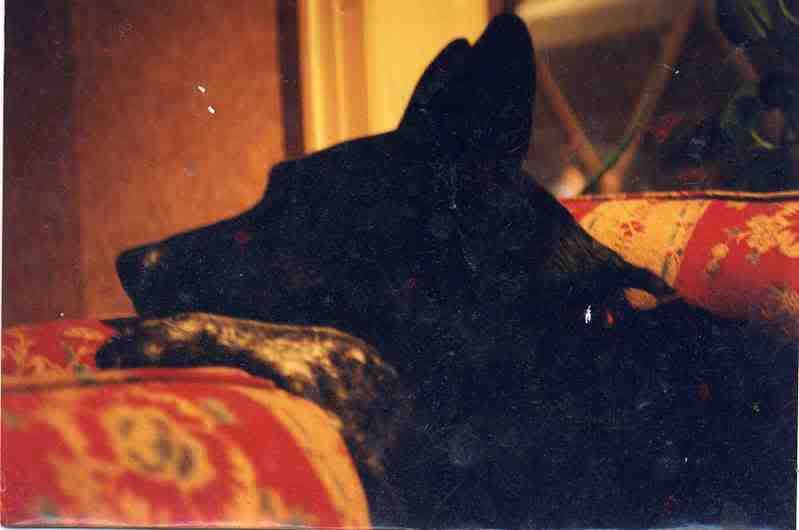
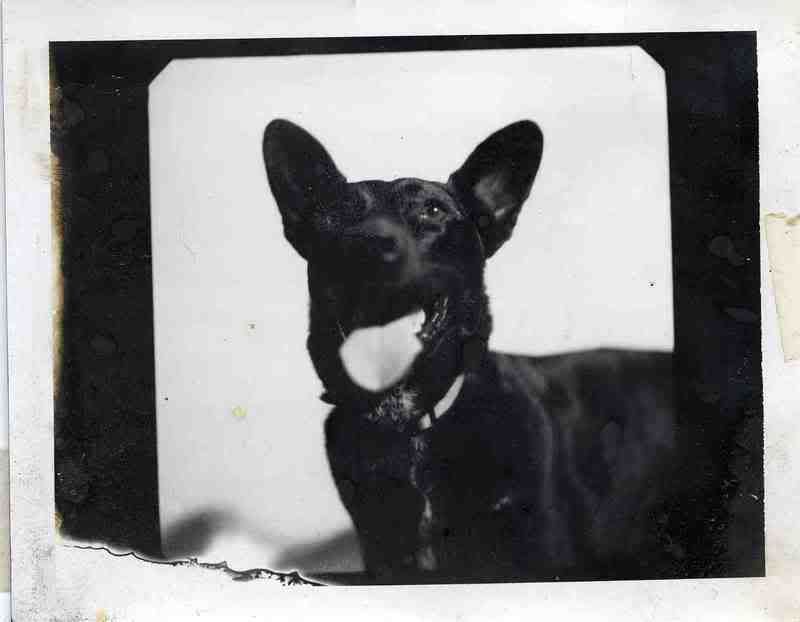
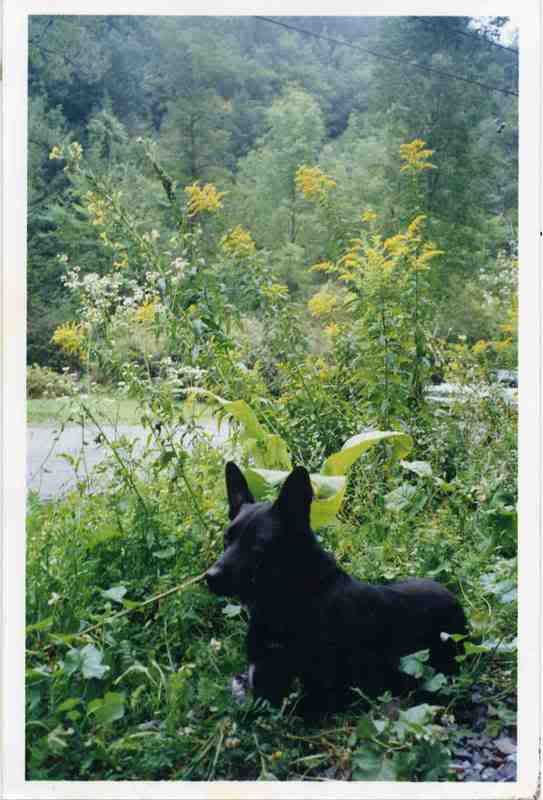
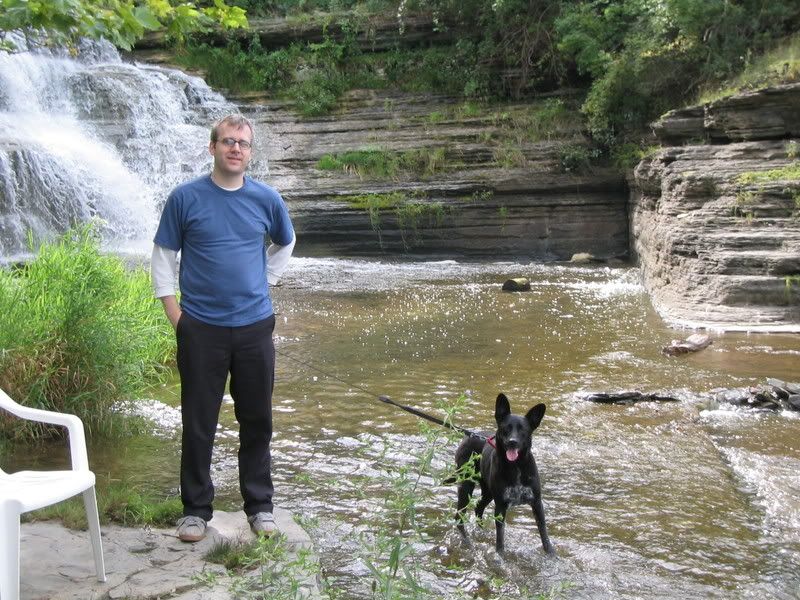
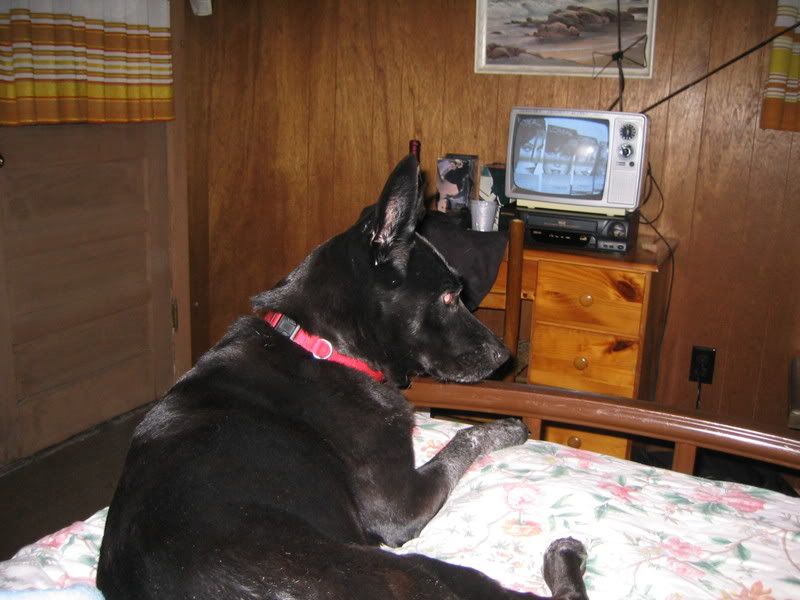
The above three photos all capture specific aspects of Haley's personality - her physical expressiveness, from her jackal-like ears to the regal look of her sitting in the green brush to the love of life shown when she is at play.


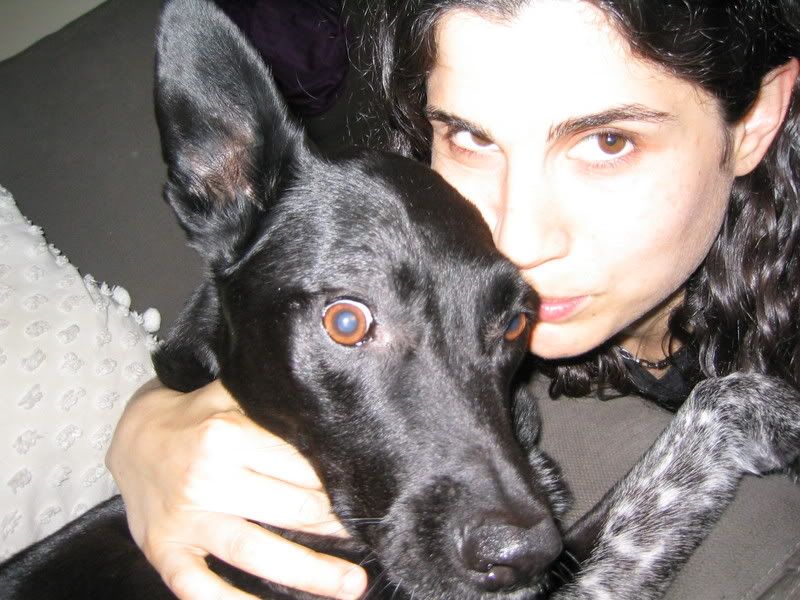
Sara and Haley - partners in crime for 15 years ever since Sara kidnapped, er, rescued Haley from the streets of West Philadelphia. Sara's re-telling of Haley stories from those early days was great comfort to us during the week we knew her end was imminent.


The above photo was taken during a visit to Farm Sanctuary in upstate New York. Haley had a great weekend. She ran through this water with her mouth open against the current of the water, scooping up as much as she could. This weekend, in retrospect, was also the beginning of her neuropathy (see also this posting for more on this weekend).


This was the cabin we stayed in on the visit that weekend. At night, rather than join in the bed, Haley insisted on squeezing under the bed to sleep. Anyone who knows Haley knows that this was odd behavior indeed. She loved sharing the bed, couch, wherever with us. For some reason, in this cabin, the floor under the bed is what worked best.


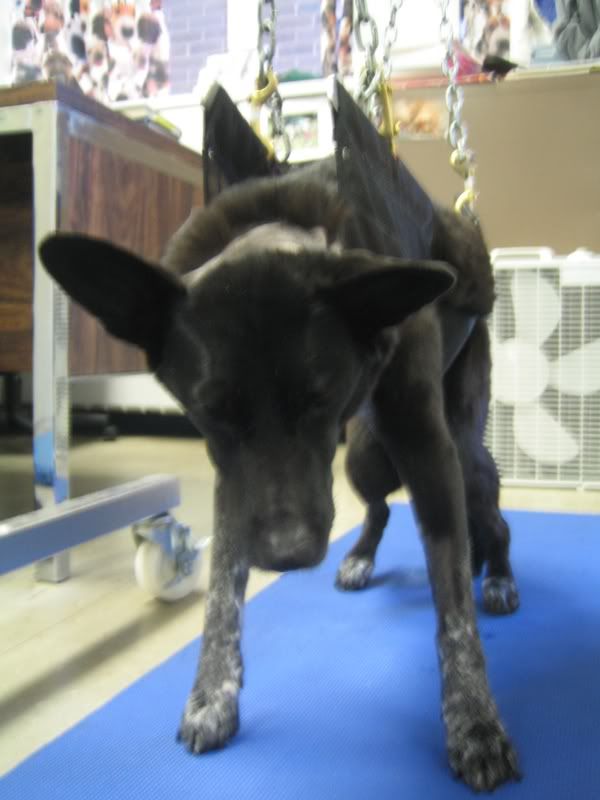
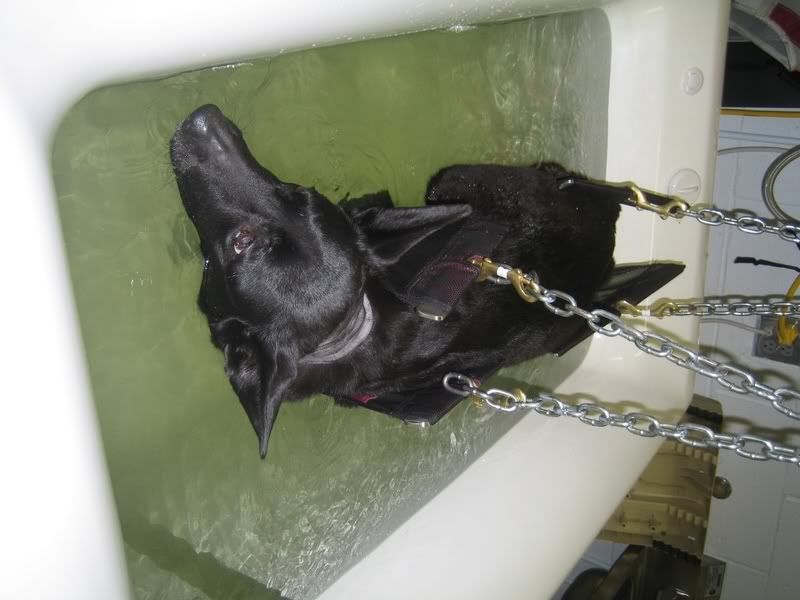
We awoke one night in Ocotber 2006 with a thrashing Haley on the bed. Her eyes was vacant and her legs were twitching uncontrolably. I picked her up, with my hand on her heart to make sure it was beating and we raced outside to hail a cab to bring us to the 24 hour animal hopsital. Haley had a seizure. No reason was found for why she would have one. We began rehab right away. Above are two photos from her early days at Animal Medical Center where she was craned into a pool for therapy. It was in these weeks directly after this episode that haley showed us her true will to live. She wanted to walk again and she did.


Haley and Leo. Fast friends right from th start. In her waning weeks, when Haley's body betrayed her, she remained alert and lively in spirit. She loved having Leo climb the couch to pat her legs or grab her front harness and pull himself up. He always greeted him with a lick. Friends or babysitters, strangers to Haley would not be allowed near Leo without a bark or two (or three or four...). It seems our brining Leo home had given Haley another reason to live.

Haley


On Thursday, February 14, 2008, we said goodbye to Haley, our wonderful companion and, by all accounts, The Greatest Dog That Ever Lived. Haley battled old age, neuropathy, and a strange seizure in October 2006, before we decided that she had fought long enough. Coincidently, when Sara first rescued Haley, she backtracked her birthday, based on the age estimate the vet gave her to February 1992. Haley's unofficial birthday was always Valentine's Day.

Since October 2006, when Haley suffered a seizure in the middle of the night, we've had home visits by a veterinarian who specializes in electric stimulation and acupuncture. The seizure had left Haley totally nonambulatory. We began an intensive rehabilitation program. Thrice a week visits from the vet, weekly swimming at the local dog pool. We stood her up, zapped her with a hand-held stimulator on the days the vet didn't come. After a few days, she began to use her front legs again. Soon, she was able to sit up. Shortly after, she began moving her hind legs. The day she, Bambi-like on the ice, stood up on her own was one of excitement and joy. With the aid of a harness for her hind legs, we started taking her on proper walks. Just a few months after the seizure, she was walking up and down the block again, with very little assistance from the harness.

Unfortunately, she also suffered from a neuropathy that strikes Shepherd dogs (Haley is assumed to be part Shepherd) making her hind legs weak as her spine is unable to send signals to those legs (or something like that). As time went on, little by little, her hind legs got weaker and weaker. Around November 2007, a full year after her seizure and subsequent rehab, her walks had diminished to short distances with some dragging of the legs (especially the left hind leg) and with considerable struggle. At home she stopped getting around on her own. We were able to guide her when she needed it, but frustration set in for Haley.

Still, we continued her visits from the vet, now bi-weekly, and we continued walking her three times a day. Some days she looked forward to the walks. Other days, it was a struggle. Others, she looked forward to going out, but struggled once there. In late January 2008, it became a struggle on every walk. She stumbled and dragged. Her head hung low. At home, she slept or panted heavily. She barked at every stranger in our home, every buzz of the intercom, every ring of the bell. She was guarding us, we knew, in her now limited way. Her appetite remained intact throughout, a positive sign as we saw it. But after consulting with the vet, we decided to put her down before her full deterioration set in, before she suffered.

Thursday, both Sara and I stayed home from work to give Haley a relaxed and comfortable final day. I had bought apples and Tofurkey slices, two of her favorite foods, to spoil her through out the day. Later in the evening, the vet and an assistant came to our house. We sat next to Haley and stroked her head. The vet gave her a sedative and we continued to stroke her head while she got sleepy. Her eyes got glassy, her tongue stuck out just a little, as was her habit when sleeping, and we said our final goodbyes.

After she passed on, the service to pick up her remains arrived at our house. The buzzer buzzed then the doorbell rang. The vet, her assistant, and the driver were all in the house. There was no barking. Our house felt empty. It will take a while, I suspect, to get used to this silence.

Sara and Haley were together for 15 years. I knew Haley for about 6 years. Leo knew Haley for 9 months. Haley and Leo got along swimmingly. Leo loved to climb her back and Haley loved to lick food from his hands and cheeks. She will be missed and will always be remembered.

Thursday, January 03, 2008

Movies 2007 Rountable Spectacular


Part VI: Where Nimero begins to talk about that which he does not know

Click here for Part I of this roundtable
Click here for Part II of this roundtable
Click here for Part III of this roundtable
Click here for Part IV of this roundtable
Click here for Part V of this roundtable


Colbinski, I like your take on both characters you mention. But only one character and one of those movies has really lingered in my mind. Daniel Day Lewis as Daniel Plainview in Blood is his normally commanding self, so much so that I am probably taking his performance for granted. Day Lewis has the ability to encompass his character fully while making everyone else around him believable too; that all the acting in this movie appears effortless. There were many wonderful scenes. The opener you mention is great but what stands out more fully is the derrick fire after the first big oil strike. The excitement and pandemonium all around. The camera sweeping in and out following Plainview as he runs around and tends to his son. The blaze always in the background like a supporting character. It was exciting and I felt as if I should shield my eyes from the fire’s brightness and grab a pail of water to help out. At this point I was willing to be swept away into the undertow of the story and let it take me over. It never happened. I remained engaged and intrigued. I think it is a powerful, very good film and I highly recommend it. It just didn’t resonate with me much since I left the theatre. I don’t see Plainview as a great character and the film itself hasn’t left me pondering it any further.

Contrawise, I agree with you about Wei Tang’s job as Wong in Lust, Caution. I can still see her ruby red lipstick on the coffee cup, feel the gaze from her smoky eyes as she readies to seduce Tony Leung’s Mr. Lee. I remember her innocence as she bravely joined the theatre group in college and shared her enjoyment upon her surprising success. I was as uncertain as she was concerning her final decision. All this sticks in my mind even though the first thing I said upon exiting the theatre was “It was way too long.” Then over the next couple of days I couldn’t get the story out of my head. After sussing it over I finally understood everything. It all hit me like lightning a few days later. Like lightning, the film left an indelible mark on me. Perhaps, I am confusing my dull-wittedness in taking three days to “get” the movie with said movie being great. Anything is possible. I still think the movie is too long and some of the sex scenes belabored but Lust, Caution is one of the best of the year.

Two other movies that stayed with me after leaving the theatre this year were The Host and In-Between Days. I won’t rehash either one as the linked reviews, ably done by you and me, respectively, can catch everyone up on why we liked those movies. I do want to look at In-Between Days and Juno together and explain why I greatly enjoyed one and was nonplussed about the other.

Now, I realize it is not fair to either film to compare or contrast as they differ vastly on many points. Other than some similarity in content - teenage girls who make certain decisions about sex and face consequences from those decisions - both films are considered “independent.” I begin my review of In-Between Days thusly:
“This small film represents what I enjoyed about independent movies when the word ‘independent’ first came into vogue. The recent change to films that seem to be all zany families, quirky characters or outlandish situations can make one forget how enjoyable indies used to be.”

The beginning of Juno was everything that is terrible about American indies. I suffered through the first fifteen minutes of this movie. Suffered terribly. It started with intrusive, loud, quirky music, continued into a precious water-colored image of Juno walking around town sipping a Big Gulp while the credits rolled, and ended in a mini-mart where the too-cool-for-school Juno cracked wise with a Comic Book Guy wannabe while purchasing a home pregnancy test. My main problem with indie film is that you can always use quirky and precious as an adjective and not be wrong. Thankfully, Juno’s hipness stopped grating on me long enough to actually warm up to her and provide a decent, but not great by any means, movie. I also grant that after seeing this and saying to myself “So what” the underwhelming feeling I have may be a reaction to the exalted status that Juno is currently enjoying. Reviews proclaim how real-life it is and how daring it is to take on teenage pregnancy. I don’t get it. There are good scenes, funny scenes and touching scenes. But nothing earth-shattering and nothing coming close to real. I am probably completely out of touch with what a real 16-year old girl is like these days and therefore talking out of my ass but I don’t think it is Juno. One aspect of the film that has been praised is how she feels like an outcast when pregnant and in school. True. But the entire rest of the film portrays her as an outcast – she’s in a cool band, dresses in raggy t-shirts, and adores 1980’s punk. Sixteen year olds who did this in my high school during the 1980’s stood out and were considered outcasts. Add to Juno a pop-culture awareness that dwarfs most everyone else and I found this character to be false. Having said all this I did warm up to her, regardless of this phoniness, and I was pulling for her by the end of the movie. And a big saving grace for Juno is that the eponymous character is the most quirky one around. I wouldn’t have been able to stomach it, if like all other indie films, she was surrounded by quirky family and friends.

Now, Aimee, the young heroine from In-Between Days, seems more real. I find myself relating more to Aimee than to Juno. On its face this is absurd. Aimee is a teenaged immigrant from Korea living with her mother, dreaming about her absent father, and just trying to fit in with her peers. Maybe the whole feel of In-Between Days won me over. In-Between Days is close and personal while Juno looks like it came right out of a film school mind into a studio’s lap. But the two girls are so different (again I have no idea what I am talking about when it comes to teenage girls). Aimee struggles through her first crush and rejection and ends up with a guy she now might or might not really like. Juno is with a cool band member who digs her like no one else. Aimee just needs to know someone accepts her. Juno doesn’t give a rat’s ass what others think of her (until she’s 9 months). Aimee has trouble communicating with friends and even with her busy mother. Juno has the most supportive family one could hope to have if you are a teenager and pregnant. Aimee ends the movie as confused as she was when it began. Juno learned a nice lesson about herself and love. Mainly, I think it comes down to this between Aimee and Juno. Aimee is who most people were in high school and Juno is who most people like to think they were.

Colbinski, I am lapping you in posts! Get to it!

Wednesday, January 02, 2008

Movies 2007 Rountable Spectacular


Part V: The marvels of celery

Click here for Part I of this roundtable
Click here for Part II of this roundtable
Click here for Part III of this roundtable
Click here for Part IV of this roundtable

Well, despite my prowess in fantasy football pick ‘em, maybe I am a movie snob. Better than a goddam hipster.

I am not sure how much more I have to say on The Bourne Ultimatum or Brand Upon The Brain! other than the former is the best action/thriller movie I have seen and the latter was my favorite movie-going experience of 2007. But I’ve already said that twice. So now having built up these two movies I must expound. The pressure mounts. But after my continued griping it will be nice to talk about what I liked.

I place The Bourne Ultimatum in the action/thriller category to separate it from action/adventure movies like Raiders of the Lost Ark. Both are well done and non-stop but they are different types of movies. If there is a better category let me know. The entire Bourne trilogy has been a very pleasant surprise. The Bourne Ultimatum is the best of the bunch. Like The Bourne Supremacy it leaves off where its predecessor ended and then just doesn’t stop engaging. There wasn’t a moment to rest as you are swept along from one foreign city to another until the climax in the Big Apple. Even Julia Stiles’ twitching eyebrows school of acting couldn’t divert me. Now, I’m a sucker for the protagonist who is better than everyone else and always one step ahead of those chasing him. Matt Damon plays this type in Jason Bourne perfectly. Always a calm demeanor, finishing up looking over a building plan and walking out a half-second before someone walks in, seemingly giving up his position to know exactly how to get his fat out of the fire. The movie is taut and compelling. There is a sense of urgency that drags you along. An excellent scene has Bourne on a phone walking through a crowded area giving directions to someone on how to leave the same area unnoticed. All the while he is taking out government operatives. Everything happens so convincingly and slyly. Sometimes when I am in a crowded place I wonder what it would be like to have a Bourne roaming through, chased by people just like him, but never noticing anything out of the ordinary. The Bourne series, and this movie in particular, creates a world I don’t think exists, but think maybe, could exist and, further, think it would be cool if it did exist. (Not cool in a we have a government that trains expert killers and then disposes of them unceremoniously when their usefulness expires sort of way. Just cool is all.)

A different movie in every way is Brand Upon the Brain! Although The Saddest Music in the World and Dracula: Pages from a Virgin’s Diary were great, I haven’t been enthusiastic about everything director Guy Maddin has done. Cowards Bend the Knee was so-so and his shorts seem repetitive. Brand Upon the Brain! was great, not only due to its content – an autobiographical story of a man going back to the island lighthouse orphanage where he grew up – but because I saw it live. Yes, live. It was still moving pictures projected onto a screen but accompanied by a real-life narrator, a real-life orchestra, and real-life Foley artists. The narrator and orchestra gave feeling to the pictures flicking before my eyes without being a distraction. I wish I could say the same about the Foley artists. Three people decked out white lab coats and safety glasses seamlessly creating the sound effects. I may be imagining the safety glasses but they fit the atmosphere as I now imagine it. The wind whistling, the waves crashing, the pitter-patter of children’s steps up and down the lighthouse’s long never-ending spiral staircase. And the celery! My god, mounds of celery crunched and squeezed to make superb sounds! A boat on the water, the creaking of a floorboard, a mother's muffled voice. Is there anything celery can't do. What it lacks in flavor it supplies in versatility. These people are geniuses. For much of the movie they mesmerized me. I’d hear a sound and look quickly to their pit to see how they made it. Of course I was too late. So, then I’d have to anticipate the next sound and make a premature glance all the while being lulled by the narrator’s smooth voice. It was like listening to the soundtrack. Amazingly, if the narrator, orchestra, and Foley artists were all out of sight you wouldn’t believe you just watched everything live. It was fantastic. I would see more movies with live accompaniments. But, for sure, Guy Maddin and his modern Cinema-Scope style is the best suited to something like this.

Colbinski add your thoughts to Brand Upon the Brain!

Tuesday, January 01, 2008

Movies 2007 Roundtable Spectacular


Part IV: Lingering Character Studies

Click here for Part I of this roundtable
Click here for Part II of this roundtable
Click here for Part III of this roundtable


Relishing the lowbrow, exalting in the highbrow, and ignoring the middlebrow is a pretty decent modern definition of a "snob" as it concerns popular culture. But then, I know that your taste for genre and b-movies are genuine and were built on comic books and Saturday afternoon Hammer films and the 4:30 movie (Planet of the Apes week! Godzilla week! Elvis week!)rather than the hip post-modern irony that attract so many to the low budget and bad movie fold. (And,I'm sure, there's a snobbery at work in the above statement on my part as well. Oh,well.)

Back to movie talk. There's been two movies this year that really rattled inside my head for days after I saw it: Ang Lee's Lust, Caution and Paul Thomas Anderson's There Will Be Blood (you know we've entered a "highbrow" discussion when I preface the movie, er, film, titles with the director's name). The key to both of these movies is that they contain intricate, complex and unique character studies of the main character. This is coupled with an intricate, complex and unique study of place. And all of this is established, in both movies, in the opening sequence. There Will Be Blood opens with an ominous buzz as the camera pans down from a mountain-scape to show a single man working. The scene ends with the man showing the desire to survuive (or, as we learn later, not fail)and the camera pans back up to the mountains and the ominous buzz kicks in again. A brilliant opener that casts the American west in 1898 and this man as inseparable and of a piece. As the story moves on through the decades, this relationship becomesmore entwined between the man, Daniel Plainview, and the oil rich, sun-baked California terrain.

Similarly, in Lust, Caution, the opening establishes place and character and sets up the tension of what will slowly unfold. Lee's camera cricles a majong game and follows the action on the table as the women interact. From this, at times catty and intense, exchange we learn much about the youngest women, Wong Chai Chi, and, as the movie back-pedals to lead back to this game, we see this game through a new lens.

The trajectory and choices of these characters is the main reason why these movies have stuck in my head. In Plainview's case, it's hard to pinpoint when the land - or what's in the land - transforms him. He seems a charming huckster at first. How much of the early Plainview is sincere? When did the greed steep in and turn him ugly? Was it always there?

Wong's main choice had me boggled for some time after. The scene is wonderfully played out and the aftermath heart-wrenching. Soon afterward, I realized that Wong reveals the answers to these questions in a an outburst of anger and frustration. Plainview, in angry and frustrated outbursts only hides himself deeper. Two very different movies, two lasting impressions.

Now, Nimero, quit beating around the bush, and finally get to your impressions of Brand Upon the Brain! and The Bourne Ultimatum.